GFC Hair Loss Treatment in Andheri West, Mumbai




GFC Hair Loss Treatment in Andheri West, Mumbai | Growth Factor Concentrate Therapy, Benefits, Procedure and Results
For people searching for GFC Hair Loss Treatment in Andheri West, Mumbai, Pure Bella Clinic offers hair-loss and GFC-related aesthetic treatments at its Andheri West location. The clinic lists GFC among its hair-loss treatment options and identifies Dr. Manisha Dubey as its founder, describing her as an aesthetic physician, trichologist and nutritionist with 6+ years of expertise.
GFC Hair Loss Treatment in Andheri West, Mumbai at Pure Bella Clinic
If you are specifically looking for GFC Hair Loss Treatment in Andheri West, Mumbai, location is only one part of the decision. The more important question is whether the clinic takes the time to understand why your hair is thinning.
Pure Bella Clinic is located in Lokhandwala Complex, Andheri West, Mumbai, and lists hair-loss treatments including GFC. Its website identifies Dr. Manisha Dubey as an aesthetic physician, trichologist, and nutritionist and states that she has more than six years of experience.
Why Choose Pure Bella Clinic?
What Is GFC Hair Loss Treatment?
GFC stands for Growth Factor Concentrate.
Your blood contains several components, including red blood cells, white blood cells, plasma, and platelets. Growth factors are proteins that play a key role in cellular repair, regeneration, and tissue healing.
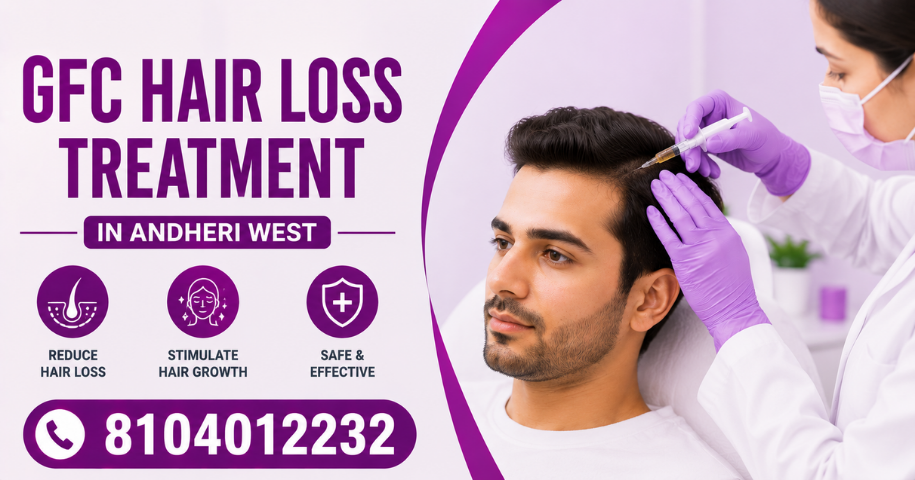
During GFC therapy, a small amount of your blood is collected and processed in a centrifuge. This separates and concentrates the growth-factor-rich portion of the plasma. The prepared GFC is then injected into selected areas of the scalp.
The treatment therefore uses your own blood-derived material rather than introducing a completely unrelated substance into the scalp.
GFC preparation involves drawing blood, processing it in a centrifuge to concentrate growth factors, and injecting the resulting preparation into the area being treated.
Why Are More People Considering GFC for Hair Loss?
Hair loss can have many causes, including genetics, hormonal factors, nutritional deficiencies, certain medical conditions, medications, stress, scalp disorders, and other factors.
Because the cause matters, treating hair loss only from the outside may not solve the underlying issue.
Hair loss can sometimes be associated with an underlying disease and that treatment depends on the reason for the hair loss.
GFC has attracted attention because
- It uses the patient’s own blood-derived growth factors.
- It is minimally invasive.
- Treatment is performed in a clinical setting.
- It may support hair density in appropriate candidates.
- It can potentially be incorporated into a broader hair-restoration strategy.
- It generally involves little downtime.
- It may be considered for both men and women depending on diagnosis.
Who May Be a Candidate for GFC Hair Treatment?
A consultation can help determine
- What type of hair loss you have.
- How long you have been experiencing it.
- Whether follicles are still active in the affected area.
- Whether there is an underlying scalp condition.
- Whether another treatment may be more suitable.
- Whether GFC could form part of a combination treatment
GFC is particularly discussed in relation to pattern hair loss. The American Academy of Dermatology explains that growth factor concentrate therapy can be used for some patients with hair loss and that treatment schedules commonly involve an initial series followed by maintenance sessions.
Get In Touch
Who May Not Be Suitable for GFC?
A medical professional should determine whether GFC is appropriate.
Certain conditions or circumstances may affect the suitability or effectiveness of treatment. For example, Cleveland Clinic notes that some patients with underlying disorders or certain medication use may not be ideal candidates.
Your provider may therefore ask about
- Existing medical conditions
- Current medications
- Blood-related conditions
- Scalp disorders
- Previous hair-loss treatments
- Allergies and sensitivities
- Pregnancy or breastfeeding, where relevant
- Your hair-loss history
- Family history of hair loss
If hair loss is sudden, patchy, accompanied by scalp inflammation, or associated with other symptoms, diagnosis should come before cosmetic treatment.
How Many GFC Sessions Are Needed?
This is one of the most common questions people ask before starting GFC.
There is no universal number of sessions that applies to every patient.
Treatment frequency depends on
- Type of hair loss
- Severity of thinning
- Treatment response
- Age
- Scalp health
- Medical history
- Overall hair-growth goals
- Provider’s clinical protocol
The AAD describes an example schedule involving monthly treatments initially, followed by maintenance injections every few months.
This is why a clinic should not promise that exactly three or four sessions will produce the same result for everyone.
What Are the Benefits of GFC Hair Treatment?
When appropriately selected and professionally performed, GFC may offer several potential advantages.
1. Uses Your Own Blood-Derived Material
GFC is prepared from the patient’s own blood.
This makes it an autologous treatment, meaning the material comes from the individual receiving the procedure.
2. Minimally Invasive
Unlike hair transplantation, GFC does not involve surgically moving hair follicles from one area to another.
It uses injections rather than an incision-based transplant procedure.
3. May Support Hair Growth
Research suggests GFC may help improve hair growth in certain forms of hair loss, particularly pattern hair loss.
4. May Improve Hair Thickness
For appropriate patients, the goal can include improving the appearance and density of existing hair.
5. Little Downtime
GFC is generally performed as an outpatient procedure and usually does not require significant downtime.
6. Can Be Combined With Other Treatments
Hair loss treatment is often more effective when the underlying cause is addressed rather than relying on a single procedure.
GFC Hair Treatment vs Hair Transplant
GFC and hair transplantation are different treatments.
GFC
- Non-surgical hair restoration procedure
- Uses growth factor concentrate
- Targets existing follicles
- May help reduce hair loss and improve growth in appropriate patients
- Usually involves multiple sessions
- Does not physically relocate hair follicles
Hair Transplant
- Surgical hair-restoration procedure
- Hair follicles are removed from a donor area
- Follicles are transplanted to areas with thinning or baldness
- Generally considered for more established hair loss in suitable candidates
A hair transplant may be more appropriate when there is significant permanent loss and sufficient donor hair.
GFC may instead be considered for patients who still have viable follicles and are looking to support existing hair.
The appropriate choice depends on diagnosis rather than simply choosing the treatment that sounds more advanced.
Aftercare Following GFC Hair Treatment
Aftercare instructions can vary according to the treatment protocol.
Your clinic may advise you about:
- When to wash your hair
- Which scalp products to avoid temporarily
- Exercise restrictions
- Sun exposure
- Hair styling
- Medications
- Follow-up appointments
The most important rule is simple: follow the instructions provided by your treating professional rather than relying on generic advice from social media.
Experience
Pure Bella Clinic presents its hair-loss treatment services and professional background, while patient reviews provide an additional source of local experience.
Expertise
Hair-loss treatment requires knowledge of dermatology, trichology and the different causes of alopecia. The clinic identifies Dr. Manisha Dubey as an aesthetic physician, trichologist and nutritionist.
Authority
Authoritative hair-loss content should be supported by reputable clinical evidence.
Trustworthiness
GFC may help suitable patients, but results vary. A responsible treatment plan should include diagnosis, informed consent, discussion of alternatives and realistic expectations.
Frequently Asked Questions (FAQ)
Q1. What is GFC Hair Treatment?
Ans: GFC Hair Treatment uses growth factor concentrate prepared from a small sample of your own blood.
Q2. Is GFC Hair Treatment safe?
Ans: GFC is generally considered a minimally invasive treatment, but it is still a medical procedure with potential side effects.
Q3. Does GFC work for everyone?
Ans: No. Different types and causes of hair loss respond differently to treatment.
Q4. How many GFC sessions will I need?
Ans: The number varies by patient and protocol. An initial series of sessions followed by maintenance treatments may be recommended in suitable cases.
Q5. When will I see GFC hair-growth results?
Ans: Hair-growth changes generally take several months to evaluate. Do not expect overnight regrowth.
Book Your Consultation Today
If you’re ready to transform your look and regain confidence, it’s time to take the next step.
- Address: B-312, 3rd Floor, Samartha Aishwarya, above Marks Spencer, Lokhandwala Complex, Andheri West, Mumbai, Maharashtra 400053.
- Phone: []
- Website: [www.purebellaclinic.com]
- Email:
Conclusion
Hair loss can be emotionally difficult, but the right approach begins with understanding what is actually causing it. GFC Hair Loss Treatment in Andheri West, Mumbai can be an option for selected patients, particularly those experiencing certain forms of pattern hair loss. The procedure uses growth factor concentrate derived from the patient’s own blood and aims to support hair follicle activity and hair growth.
Pure Bella Clinic offers GFC and other hair-loss treatment options from its Andheri West location in Lokhandwala. Its published approach emphasizes personalized assessment, professional expertise, modern treatment methods, and patient-focused care. If you are noticing increasing hair fall, thinning, a widening hair part, or a receding hairline, consider getting professional advice before the problem progresses.
Book Your Consultation Today: 8104012232
Visit: purebellaclinic.com
“Don’t forget to share this post!”